 Uniswap
 price impact shapes the quote while tolerance changes the minimum received
Uniswap price impact is the difference between the current market price and the execution price caused by a quoted swap. That effect is already reflected in the estimated output. Slippage tolerance does a separate job: it defines how far execution may worsen before the transaction reverts, which determines minimum received for an exact-input pool swap.
Read the route and quoted output first, then compare price impact with tolerance and minimum received. Keeping those fields in one quote snapshot shows whether the price and execution limit still fit the intended swap.
In short: Price impact shapes the quote; slippage tolerance sets how much worse execution may become before the swap reverts.
From a Fresh Quote to Confirmed Output
Three pre-signing values carry different meanings: estimated output, price impact and minimum received. The input amount and selected token contracts establish what is being quoted. The route determines which liquidity is used. Compare a fresh quote only after those inputs match the intended swap and every displayed figure comes from the same update.
Before Submission
The pre-submission check begins with the expected output, not the tolerance control. Price impact describes the cost already built into that expectation. Tolerance then creates a boundary around later unfavorable movement. Treating the boundary as a cure for the initial impact allows an expensive quote to pass with even less protection.
Quoted Output
Quoted output estimates how much of the selected output token the route will return under the pool state used for calculation. It already reflects movement along that route. A route through deeper active liquidity may produce more output than a shallower alternative for the same input. Pool fees can affect route output, while network costs remain a separate payment.
Execution Bound
The execution bound, shown as minimum received or minimum output, is the lowest acceptable output for an exact-input pool swap. If execution returns at least that amount, the swap may complete under the quoted constraint. If it returns less, the transaction should revert instead of accepting the lower output. The displayed minimum therefore matters more than an isolated tolerance percentage.
After Confirmation
A successful receipt shows that the call did not revert, while token transfer records or the resulting balance show what arrived. The received amount may beat the minimum because that figure is a floor, not a target. A reverted receipt shows that no swap output was delivered through that call.
What Makes Price Impact Grow?
Trade size relative to usable liquidity along the selected route is the main driver. Price impact is the change in token price caused by the swap itself. A larger order consumes more favorable liquidity and reaches progressively less favorable prices. The same input can therefore show different impact when active liquidity or routing changes.
Price impact depends on usable liquidity along the route, not simply on a pool’s total token balances. Concentrated liquidity may support trading only within chosen price ranges, so liquidity outside the path does not help every part of an order. Multi-pool routing can divide an input across sources when that construction produces a better quote. Changing the input amount can also produce a different route, making simple percentage comparisons incomplete.
Tolerance Sets the Execution Floor
For an exact-input pool trade, higher tolerance lowers the minimum output while lower tolerance raises it toward the quote. Neither setting removes the price impact already included in estimated output. If every other input and the route remain unchanged, changing tolerance alters the protective floor rather than the simulated trade.
UniswapX orders do not use the custom slippage setting applied to non-UniswapX swaps. Their quoted terms include a visible minimum output, so the order type must be identified before interpreting a tolerance control.
A Hypothetical Exact-Input Calculation
All values in this comparison are hypothetical. An unchanged pool route quotes 1,258 output units. The two tolerance choices are 0.8% and 2.8%, and the later executable output is 1,240 units. For this exact-input calculation, minimum output equals quoted output divided by one plus tolerance. The route and price-impact estimate remain fixed.
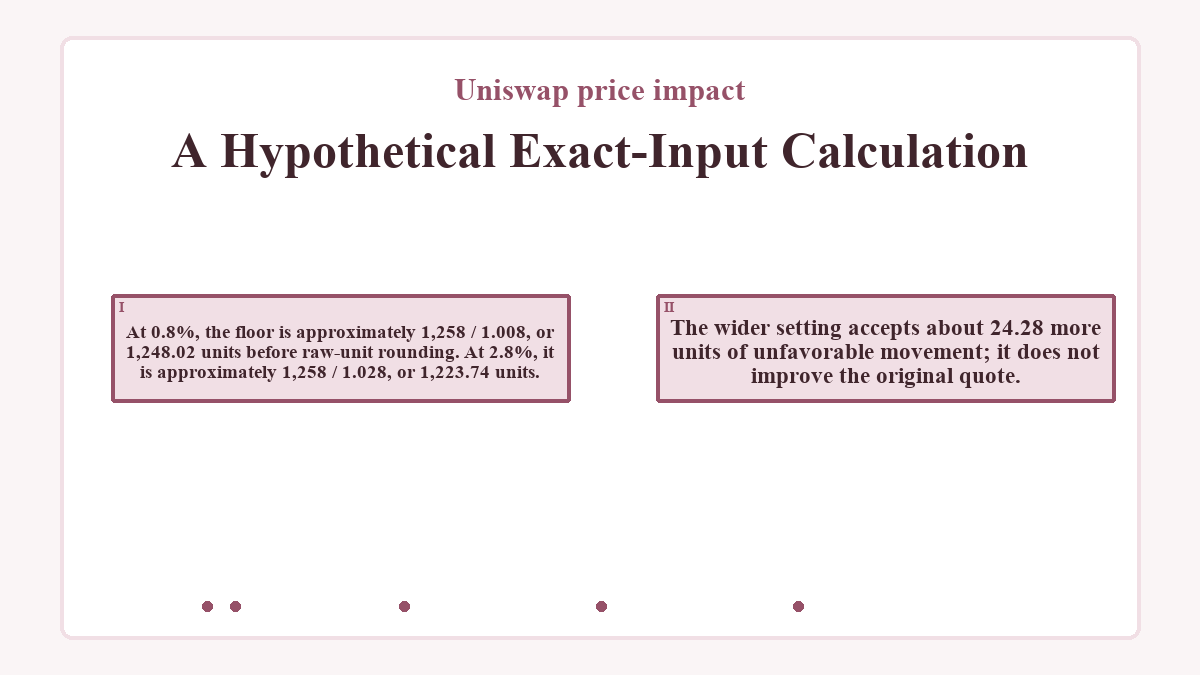
At 0.8%, the floor is approximately 1,258 / 1.008, or 1,248.02 units before raw-unit rounding. At 2.8%, it is approximately 1,258 / 1.028, or 1,223.74 units. The wider setting accepts about 24.28 more units of unfavorable movement; it does not improve the original quote.
An executable output of 1,240 units falls below the tighter floor, so that branch reverts. The same output exceeds the wider floor, so that branch can settle and the receipt can record the completed call.
Why Does a Swap Revert After a Good Quote?
A good quote can become unexecutable when pool state changes before the transaction is processed. Other swaps or rapid market activity may change the pool state before execution.
A pool swap can revert when execution moves beyond its allowed slippage bound.
A pre-submission simulation may reject the call before broadcast. Once a transaction is broadcast and processed onchain, a revert can still consume network fees because the network performed the computation.
High price impact and a slippage revert are different outcomes. An unattractive quote can execute if its minimum is satisfied, while a low-impact quote can revert after a small adverse change when tolerance is tight.
Repeated failure under a much wider bound points beyond ordinary quote movement. A token’s transfer logic, an expired deadline or insufficient network-fee balance may block execution. Tolerance cannot repair an unsupported token behavior or a transaction that lacks required funds.
Price Impact and Market Slippage
Current Quote State
The current quote contains the order’s own pool movement. If the input grows while active liquidity stays similar, average execution moves farther from the starting price. That difference belongs to price impact even when the transaction executes immediately at the quoted terms.
Movement While Waiting
The waiting transaction faces changes that occur after the quote. Price slippage is the difference between expected execution and the execution actually received. A refreshed quote absorbs newer pool state into a new expectation, price-impact estimate and minimum. Comparing an old minimum with a new quote mixes two snapshots and can make the diagnosis misleading.
Reducing Impact Without Widening Tolerance
A smaller input often travels a shorter distance through available liquidity, so quote smaller amounts and compare output per unit before accepting a route. An alternative route may use deeper liquidity or split the input across pools. Splitting separate transactions is not automatically cheaper because each transaction can incur pool fees and network costs, while earlier parts can change the price faced by later parts. Waiting for a calmer market can reduce intervening movement, but it does not create deeper liquidity.
Quote Checks Before Signing
Before signing, verify that the selected token contracts, input amount, route, estimated output, price impact, tolerance and minimum received all come from one quote snapshot. A high-impact quote deserves a size or route review before any tolerance change. A higher minimum offers stronger price protection but raises the risk of a revert when state changes. A lower minimum gives execution more room but permits worse output. Use the displayed minimum received as the execution limit rather than judging the percentage alone.
Useful questions about Uniswap price impact
Which Details Must Match When Comparing Price Impact Across Two Quotes?
A valid comparison keeps the network, both token contracts, trade direction and input amount the same. Record the route and quote time because either can change the liquidity used. If one quote is older or follows another route, the percentage difference may reflect new pool state rather than a change caused by only one setting.
How Is Tolerance Applied to an exact-output Swap?
An exact-output swap fixes the desired output, so tolerance limits the maximum input that may be spent. Price impact still describes quote quality, while maximum input is the execution guard. Review the displayed maximum input before signing because pool state can change.
Why Can a Fee-on-Transfer Token Still Fail After Tolerance Is Widened?
A fee-on-transfer token can reduce the amount delivered during a taxable transfer. On a route that supports this behavior, the tolerance may need to cover the token fee as well as adverse price movement. An unsupported route will still fail because widening tolerance does not change router compatibility. Repeated simulation failure after allowing for the fee points to a separate token or route problem.
When Can a High price-impact Quote Still Execute?
A high price-impact quote can execute when its output remains at or above minimum received. The warning describes the cost already present in the quote, while the slippage bound governs later unfavorable movement. Successful execution therefore does not establish that the original impact was reasonable for the trade.
Does Network Gas Change the Minimum Received?
Network gas does not directly change the output-token floor. It is a separate cost paid in the network’s fee token. A fresh route can change both the gas estimate and quoted output, so compare them as separate fields from the same snapshot. If an onchain swap reverts, its failed computation can still consume gas.
Can Token Decimals Make a hand-calculated Minimum Received Differ?
Token decimal precision can create a small display difference because swap contracts work with integer raw units. A percentage calculation may produce a fractional raw unit that cannot be encoded, so the minimum is rounded down to an integer raw-unit amount before it is sent onchain. The encoded onchain bound is authoritative, not extra digits from a calculator.
- updated